

After the Supreme Court's April 2026 Voting Rights Act ruling in Louisiana v. Callais, Governor DeSantis called the legislature into a special session to redraw Florida's congressional map. The map they passed, and he signed in May, reworks 21 of the state's 28 districts. Florida's delegation was 20 Republicans and 8 Democrats; by voter registration the new lines point toward 24 and 4. No other state moved as many seats.
The district that disappeared
Florida's previous redraw, in 2022, had already dismantled the north Florida district that united Black communities from Jacksonville to west of Tallahassee, most recently held by Al Lawson, splitting it among three Republicans. The Florida Supreme Court upheld that in 2025, ruling that restoring the district would itself be a racial gerrymander. The 2026 map goes further in the same direction.
The court fight
Florida's constitution has, since 2010, a Fair Districts amendment that bans drawing districts to favour a party or to deny minority voters an equal say. A voting-rights group sued in Leon County circuit court within days of the signing (Common Cause, the League of Women Voters of Florida and LULAC). On 26 May the circuit judge refused to block the map before the election, and on 10 June the Florida Supreme Court ruled it can be used in 2026. The case continues toward a trial on the merits; the map is the one Florida votes on this November.
How the map does it
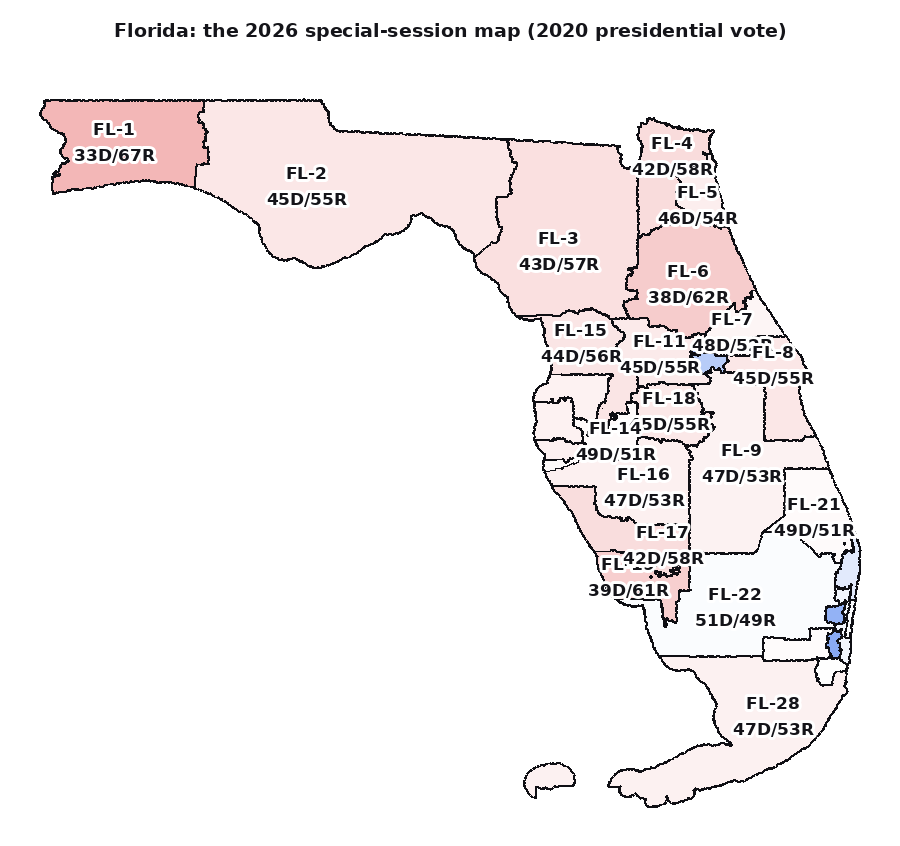
Shade each district by how it voted in 2020 and the redraw shows its hand. Under the 2022 map eight of the 28 districts leaned Democratic: the Orlando and Tampa seats, and a chain along the south-east coast from Palm Beach to Miami.
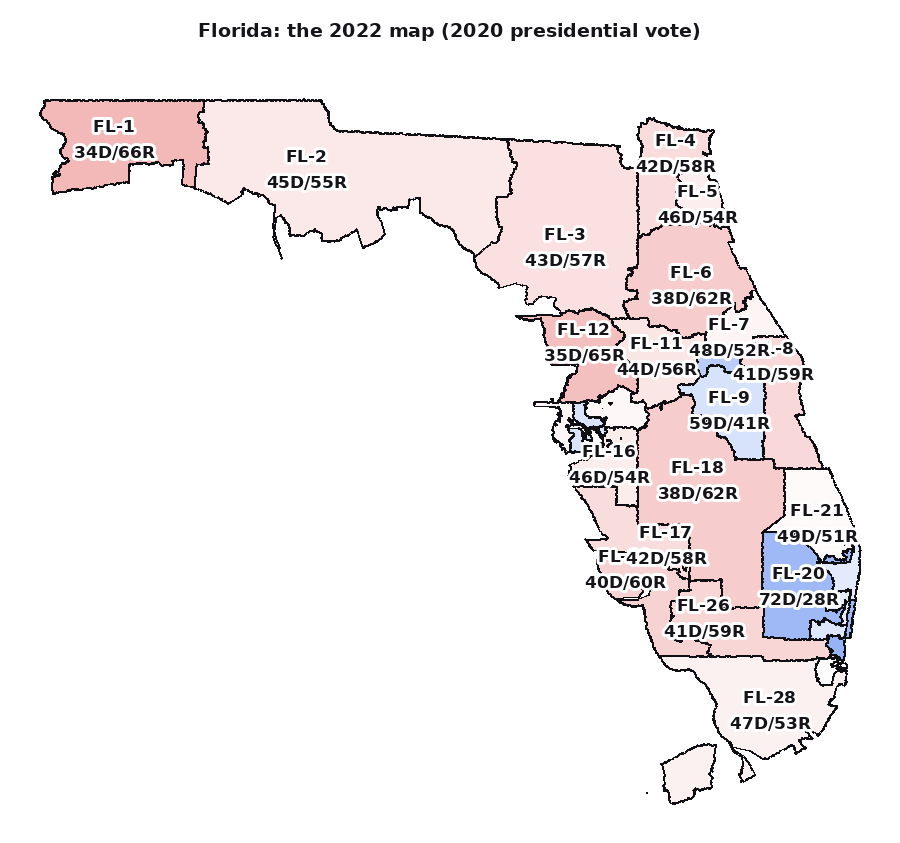
The 2026 map cracks the two inland cities. Orlando's 9th goes from 59 percent Democratic to 47 and Tampa's 14th from 58 to 49, each by trading city neighbourhoods for Republican suburbs. On the coast the Democratic seats survive but are trimmed: the 22nd from 56 percent to 51, the 25th from 58 to 53. By the 2020 vote, six districts lean Democratic instead of eight, three of them by less than three points.
Why it matters
Analysts at the Cook Political Report and Sabato's Crystal Ball put the seats shifting to Republicans from the post-Callais Southern redraws at around seven; Florida is the largest share of that.
Try it yourself
Miami-Dade votes 54 percent Democratic and is carved between four districts, three of them Republican-leaning. Keep the county's majority together, then split it, and count the seats each way.
Sources
- Florida Senate: congressional redistricting plan EOGPCRP2026 (shapefile and statistics) (2026)
- WUSF: A breakdown of the changes for Florida's new congressional map (6 May 2026)
- Ballotpedia News: New congressional maps in Florida, Tennessee aim to shift five more districts to Republicans (11 May 2026)
- The Hill: Florida redistricting special session kicks off (2026)
- MultiState: Florida Redistricting 2026, DeSantis calls special session (6 Apr 2026)
- Axios: Florida redistricting ruling protects DeSantis' map for now (26 May 2026)
- Southern Coalition for Social Justice: Common Cause et al. v. DeSantis et al. (2026)
- The Hill: 7 House seats could shift to GOP after voting rights ruling (Cook, Sabato) (2026)