

On 29 April 2026 the Supreme Court ruled, 6 to 3, that Louisiana's second majority-Black congressional district was an unconstitutional racial gerrymander. The district, running from Baton Rouge to Shreveport, had been drawn in 2024 after a court found the previous map diluted Black Louisianans' votes. The case was argued in March 2025, reargued in October, and decided by Justice Alito for the majority.
What it changes
Section 2 of the Voting Rights Act of 1965 had required states to draw districts where a cohesive minority community could elect its candidate of choice, wherever voting was so racially polarised that spreading that community across districts would silence it. As recently as 2023 the Court reaffirmed that rule for Alabama. After Callais, drawing a district because of race in order to satisfy Section 2 is itself treated as suspect. Civil rights groups describe the decision as eviscerating the Act; in practice it removes the one legal requirement that stopped mapmakers cracking Black and Latino communities.
The aftermath
Within weeks the Southern redraws began. Louisiana passed a map dismantling the district at issue on 29 May, and with a federal hearing on the challenge to it postponed, that map is the one Louisiana votes on in November. Alabama received the Court's leave on 11 May to revert to a map with a single majority-Black district. Tennessee carved Memphis's majority-Black 9th district into rural Republican seats. Florida cited the ruling when it redrew 21 of 28 districts. Analysts count around seven seats moving to Republicans as a result.
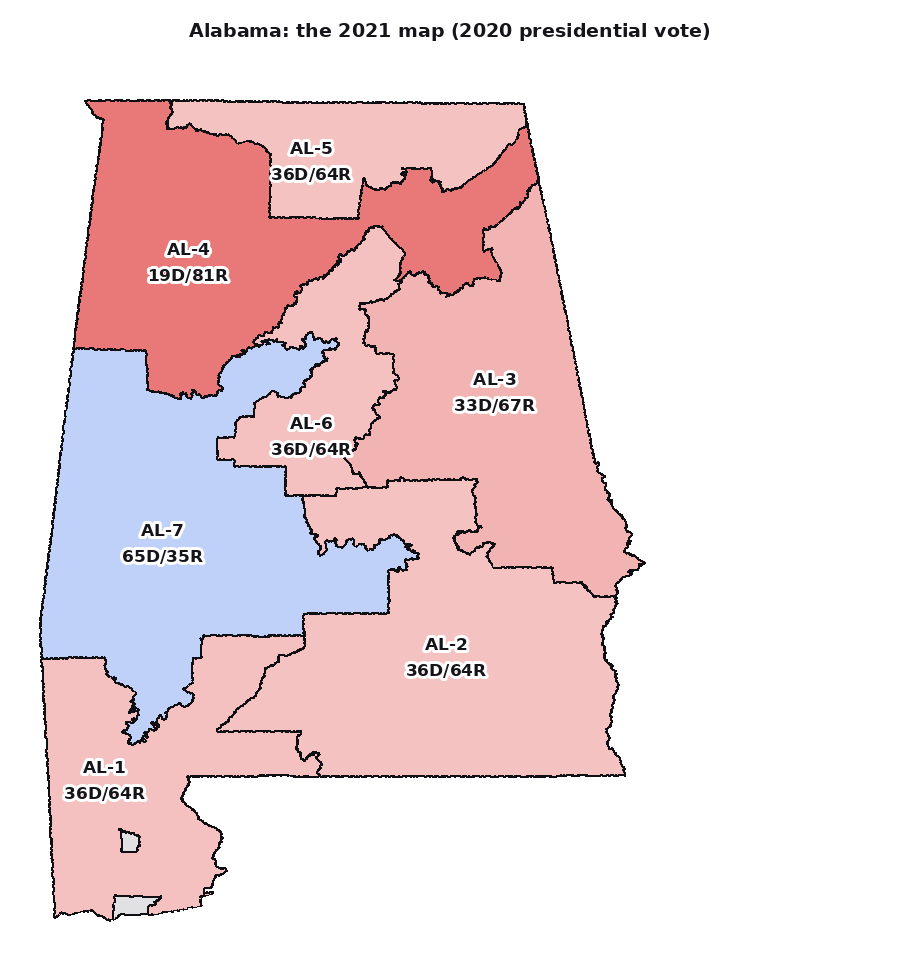
Alabama shows what the ruling undoes. In 2023 the Supreme Court had ordered the state to draw a second district where Black voters could decide the seat; after Callais it may go back to the map with one.
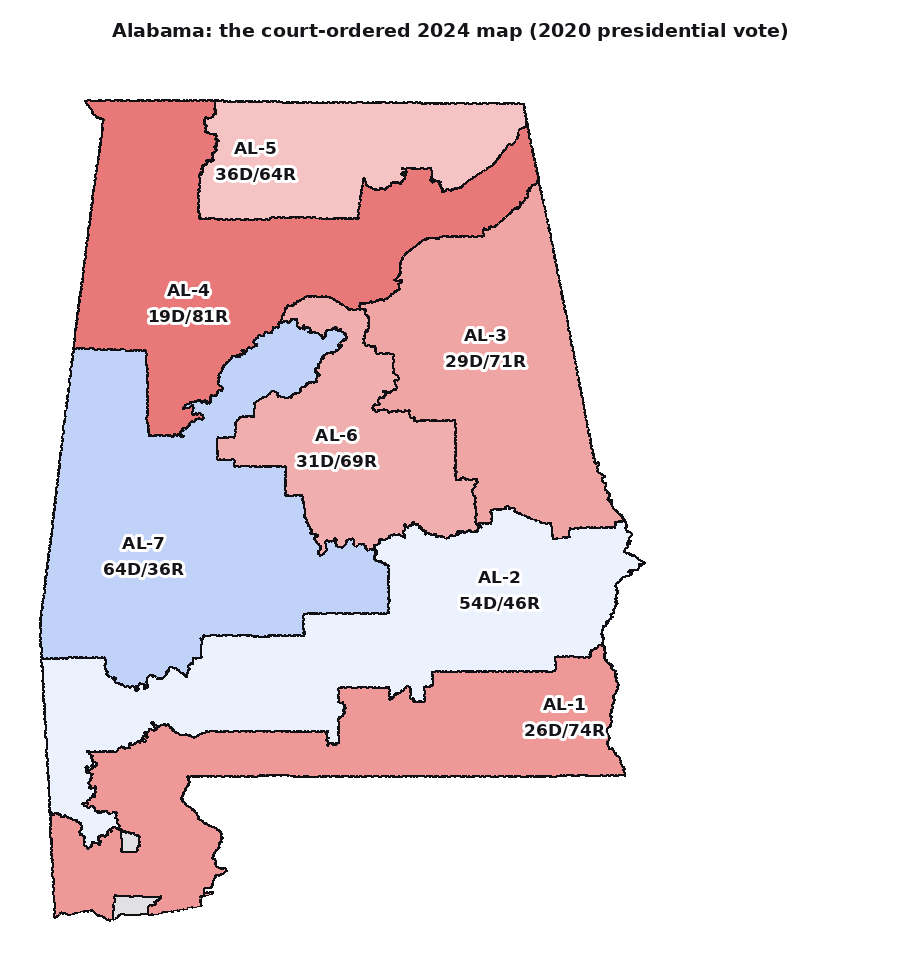
The 2021 map dissolves that second district back into its neighbours. The Black voters of Montgomery and the Black Belt are spread across seats that each lean Republican, and the 7th is once again the only district of seven they can carry.
In the game's terms
A Voting Rights Act district was the one place the law forced the lines to keep a community together. Cracking, the move the second lesson teaches, is exactly what those districts prevented: split a neighbourhood across enough districts and it elects nobody at all.
Try it yourself
Keep New Orleans or Birmingham whole, then crack it, and count the seats each way.
Sources
- Congressional Research Service: High Court Narrows Voting Rights Act in Louisiana v. Callais (2026)
- Brennan Center for Justice: Louisiana v. Callais (2026)
- NAACP Legal Defense Fund: Louisiana v. Callais (2026)
- NPR: Louisiana lawmakers pass a congressional map to dismantle a majority-Black district (29 May 2026)
- The Advocate: Louisiana likely to use new congressional map for 2026 midterms despite looming court challenge (2026)
- CNN: Supreme Court allows Alabama to eliminate congressional district held by a Black Democrat (11 May 2026)
- Campaign Legal Center: The Supreme Court has eviscerated the Voting Rights Act (2026)