

New Orleans: the Voting Rights Act on the line
Louisiana's congressional map sat at the centre of a Voting Rights Act case that reached the Supreme Court. Black residents make up about a third of the state, yet for years the map included only one district in which they were a majority, anchored in New Orleans, so their votes could elect a single representative of their choice.
Courts ordered a second such district; the state drew one; and in Louisiana v. Callais (2026) the Supreme Court held that relying on race to draw it violated the Equal Protection Clause, a ruling that narrowed the Voting Rights Act. In June 2026 the Court extended that logic to Alabama, allowing it to erase a second majority-Black district there as well. New Orleans is where that contested district begins.
You are playing the Democrats. New Orleans and its suburbs lean strongly Democratic, but those votes are concentrated in a single seat. Draw the lines so they win a majority of the districts.
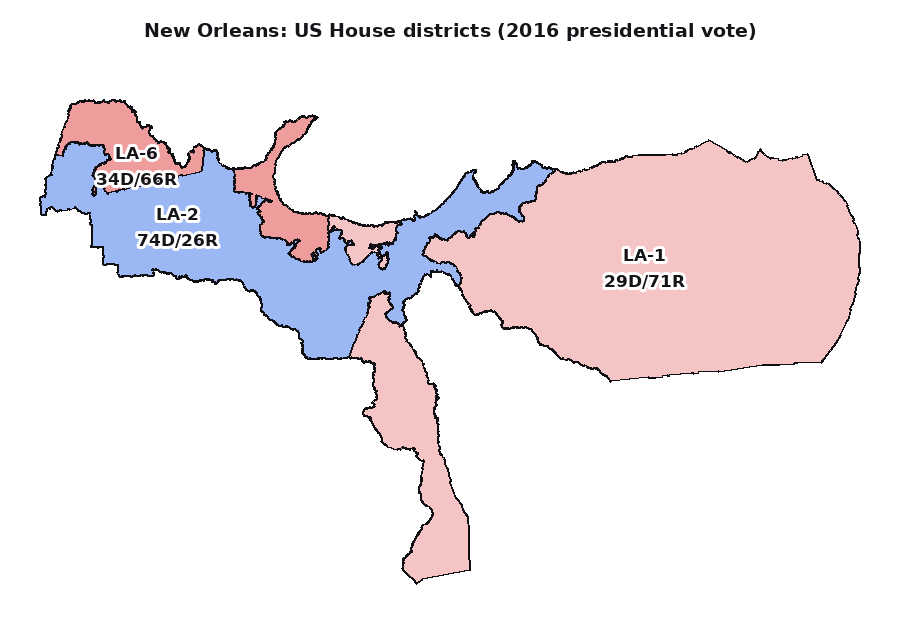
The blue 2nd District, Louisiana's one majority-Black seat, hugs the river through New Orleans; its neighbours run three-to-one Republican (2016 vote).
Louisiana v. Callais (Wikipedia)
District & election data: MGGG-States / Louisiana Secretary of State / US Census, under ODbL 1.0.