

North Carolina: where gerrymandering went free
No state has fought over its maps like North Carolina. Presidential races here are decided by a point or three. The seats are not.
This is where the Supreme Court gave up on policing partisan gerrymandering altogether (Rucho v. Common Cause, 2019, was about this very delegation), and where the original racial-gerrymander case, Shaw v. Reno, was fought over the old 12th District, a ribbon of a district that ran 160 miles up Interstate 85 collecting voters. The map at the heart of Rucho is below, drawn in 2016 after the courts threw out its predecessor; its architect announced the goal in the open: ten Republicans and three Democrats, only because he could not draw a map for eleven.
The courts eventually forced a fairer version here too, the 2019 redraw below. It did not last. When the state supreme court flipped Republican in 2023, the legislature drew yet another map mid-decade, and the next election handed Republicans ten of the fourteen seats. A fifty-fifty state, never fifty-fifty where it counts.
You are playing the Democrats. Your voters are nearly half the state, but they are piled up in Charlotte and the Triangle, where votes are easy to waste. Unpack them, and win a majority of the thirteen districts for your side.
Clinton 46.2%, Trump 49.8%. North Carolina's 2016 presidential vote.
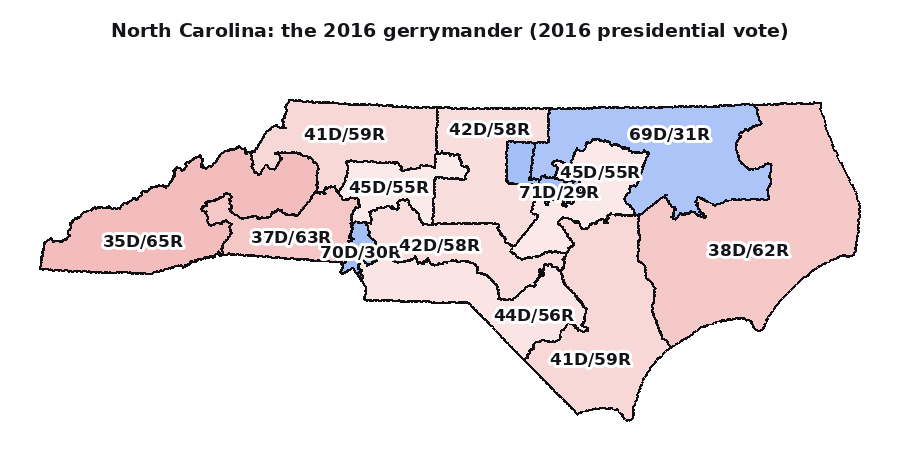
The 2016 map, shaded by the 2016 vote: three blue districts packed near 70 percent Democratic, ten leaning red. Ten of thirteen seats from half the vote.
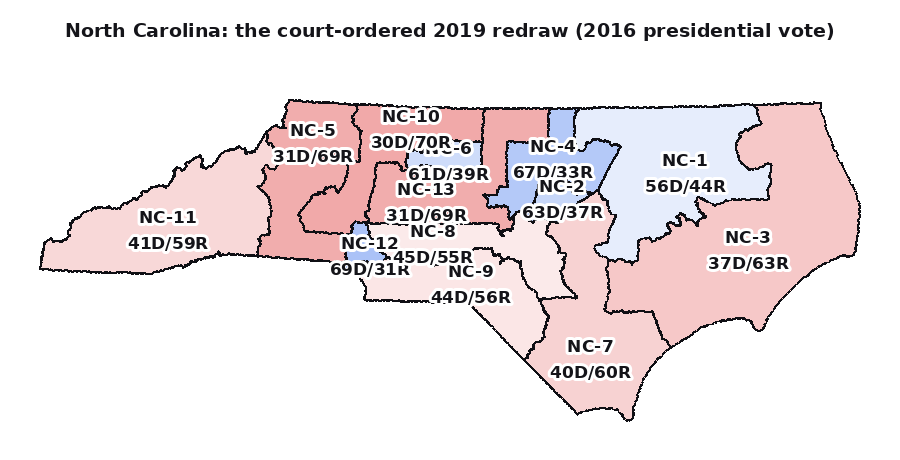
The court-supervised 2019 redraw of the same state: five seats lean blue, eight red. Fairer, though still tilted.
Rucho v. Common Cause (Wikipedia)
2023 North Carolina redistricting (Wikipedia)
District & election data: MGGG-States / North Carolina General Assembly / US Census, under ODbL 1.0.